PPE compliance detection: why hard-hat presence labels aren't enough
A hard hat in the frame is not a worker wearing one. Site cameras need to tell the difference, and most public PPE data was never labelled for it.
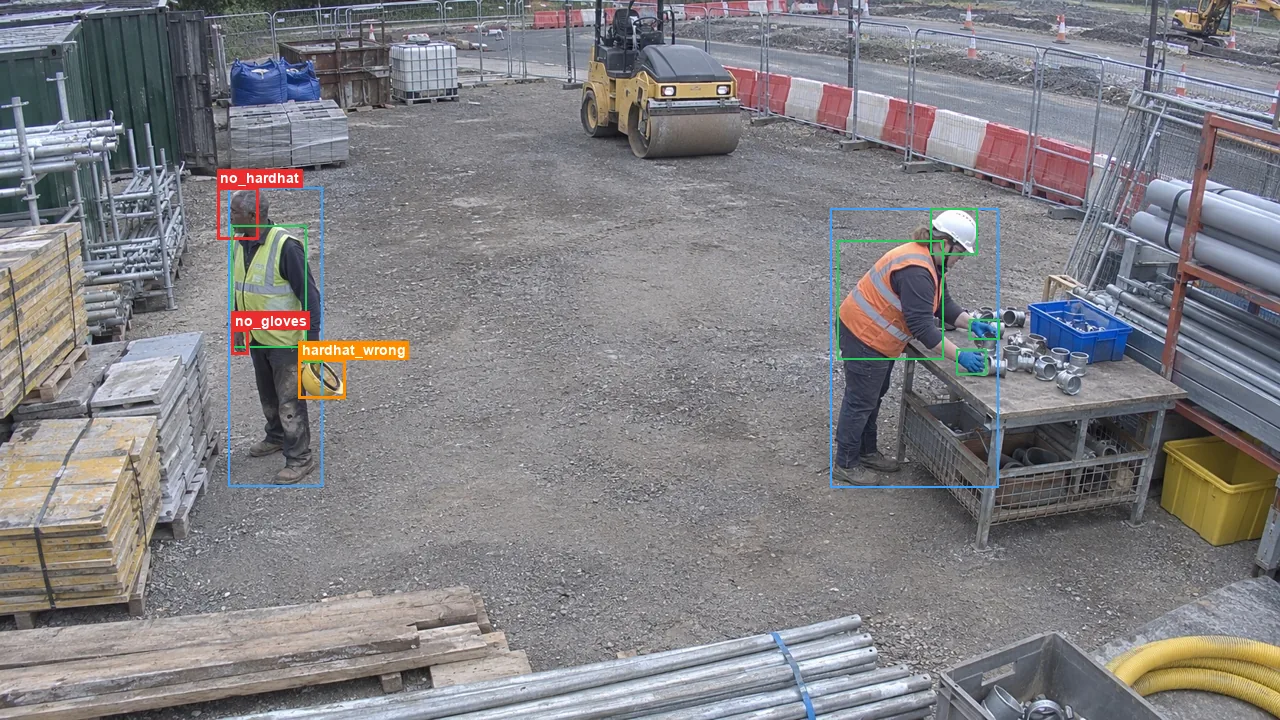
The view PPE monitoring runs on: a fixed camera several metres up, workers small in the frame.
What a site camera has to detect
PPE monitoring on CCTV sounds like an object detection problem: find the hard hats, find the vests, count them. In practice the question a safety team asks is different. It is not "is there a hard hat in this frame?" but "is every worker in this zone wearing a hard hat and a vest, the way they are meant to?"
That changes what the model has to see. A hard hat in someone's hand, a hard hat on a pallet, a vest tied around the waist on a hot day: a presence detector finds PPE in all three and reports a compliant worker. The alert that mattered never fires.
So a useful PPE model needs three things a presence model does not: it has to tie each piece of PPE to a worker, it has to know whether the PPE is worn correctly, and it has to ignore clothing that looks like PPE but is not.
Violation states and look-alikes
When we listed what a site camera actually sees, PPE fell into four states, not two:
1. Worn correctly
Hard hat on the head, facing forward, chin strap done up where the site requires it. Vest on and closed.
2. Worn wrong
Chin strap loose, hard hat worn backwards. Vest worn open, or taken off and tied around the waist.
3. Present but not worn
Hard hat held in the hand, hooked on a belt or left on a surface while the worker carries on bareheaded.
4. Missing, or replaced by a look-alike
No hard hat or vest at all, or something that reads as PPE at a distance: a baseball cap, a beanie or a hood instead of a hard hat; an orange or yellow shirt or jacket without reflective stripes instead of a vest.
The look-alikes are where most false "compliant" results come from. From 6 m up, a yellow beanie and a yellow hard hat are a few pixels of the same colour on top of a head. A high-visibility orange hoodie is the right colour for a vest and the wrong garment. A model that has never been shown these as negatives will learn "bright head = hard hat" and "orange torso = vest".

Why ground-level presence datasets fall short on CCTV
Free public PPE datasets are a reasonable place to start, and most of them have the same two properties: they label presence (a helmet class, often a head class, sometimes a vest class), and they are built from photos taken at eye level, usually with phones or handheld cameras, with workers fairly close and large in the frame.
Both properties work against a CCTV deployment:
- Geometry. A fixed camera 3 to 8 m up sees the top of the hard hat, a foreshortened torso and the vest from above. The side-on view that dominates ground-level photos is the exception on CCTV.
- Size. On a wide site camera, most workers are small. The hard hat that fills 80 pixels in a phone photo can be a handful of pixels on a site feed.
- Labels. With presence-only classes, a hard hat in the hand is labelled the same as a hard hat on the head. The model is trained to treat the violation as compliance.
- Rarity. Real footage of violations is rare. People who know they are on camera usually wear their PPE, and sites rarely share footage of the times they did not.
That last point is the reason we built this set synthetically. You cannot ask workers to take their hard hats off on a live site to collect training data, and staging it with actors gives you one site, one camera and a few people. With synthetic data we can put the camera where site cameras actually hang and choose how often each violation appears. Every image is synthetic: no real workers appear in it.
How to label compliance
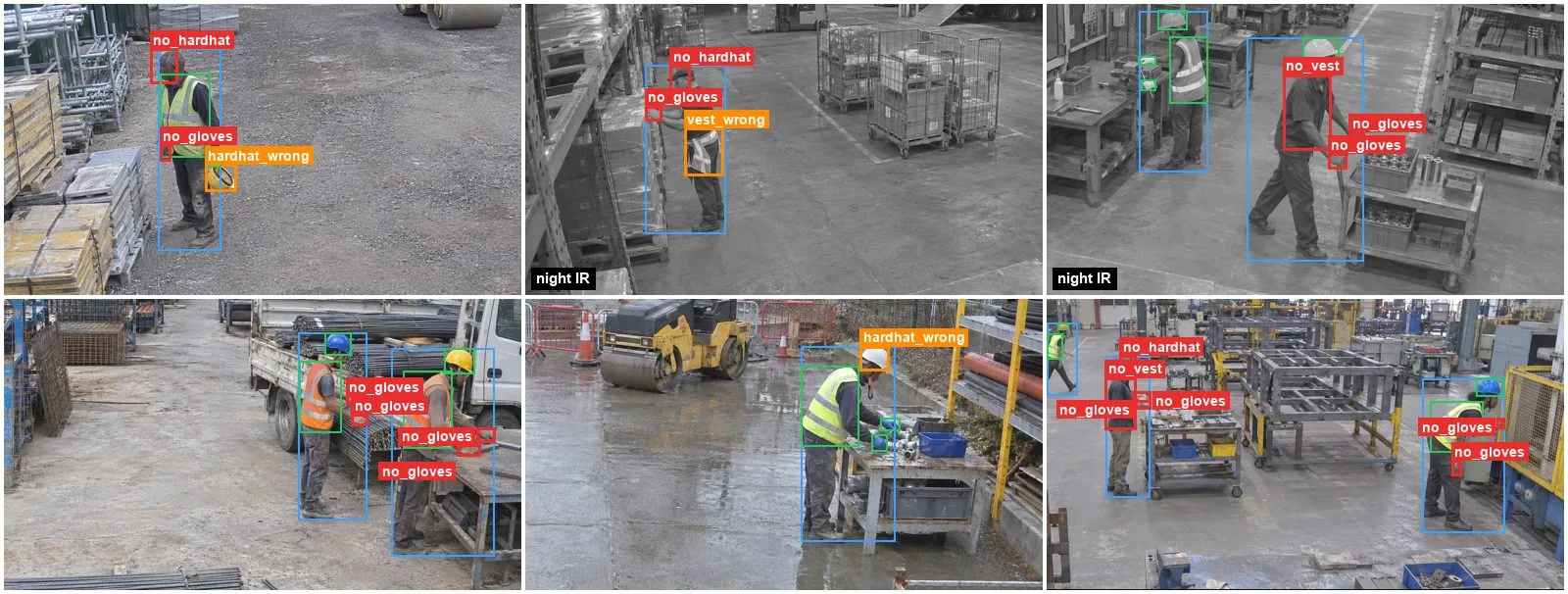
We settled on nine classes. Each PPE item gets a "worn", a "worn wrong" and a "missing" class, and the box rule says exactly where each box goes, so the model has one consistent target per state:
| Class | What it marks and where the box goes |
|---|---|
person | Every worker in the frame. |
hardhat | A hard hat worn correctly, on the hat. |
hardhat_wrong | A hard hat worn wrongly (loose chin strap, backwards), held in the hand or left on a surface. Box on the hat, wherever it is. |
no_hardhat | A worker without a hard hat on their head, including a baseball cap, beanie or hood. Box on the head. |
vest | A safety vest worn and closed, on the vest. |
vest_wrong | A vest worn open or tied around the waist. Box on the vest, at the waist when it is tied there. |
no_vest | A worker without a vest. Box on the torso. |
gloves | Gloved hands, only for workers at least about 20% of the image height. |
no_gloves | Bare hands, under the same size rule. |
A few choices behind the scheme:
- Missing PPE gets a box.
no_hardhatsits on the head andno_veston the torso. A detector cannot detect the absence of an object, but it can detect a bare head. That gives the violation a location you can alert on. - The wrong-state box stays on the item.
hardhat_wronggoes on the hat whether it is worn backwards, held in the hand or lying on a surface, andvest_wronggoes on the vest, down at the waist when it is tied there. The model learns the item and its state together, instead of a hard hat that counts wherever it is. - Gloves only where they can be seen. Hands on a small worker are a few pixels wide. Labelling them would teach the model to guess, so
glovesandno_glovesare only labelled for workers at least about 20% of the image height. - Every worker is a
person. Compliance is a per-worker decision. With person boxes you can assign each PPE box to the worker it overlaps and report "worker 3: no hard hat" rather than a list of loose boxes.
Labels were made automatically, checked by a vision-language model and reviewed visually. About 75% of the images contain at least one violation and 25% are fully compliant, so the model sees plenty of correct PPE as well as the failures.
Small workers and night infrared
The scenes are fixed CCTV views looking down from 3 to 8 m: construction sites (about 55% of the images), warehouses and logistics yards (about 35%), and factory floors and workshops (about 10%). Each frame has 1 to 5 workers, and many of them are small, because that is what a wide site camera sees.
Small workers are the hardest part of the problem. A backwards hard hat or a loose chin strap can be hard to see on a worker a few dozen pixels tall, for a person reviewing the image as much as for a model. Some practical things to check on your own validation set:
- Train and infer at a higher input resolution, or tile wide frames, before reaching for a larger model.
- Watch what mosaic and random-crop augmentation do to small workers; they can cut the head off the box you need.
- Report results by worker size. A model that is strong on large workers and weak on small ones looks fine on an average.
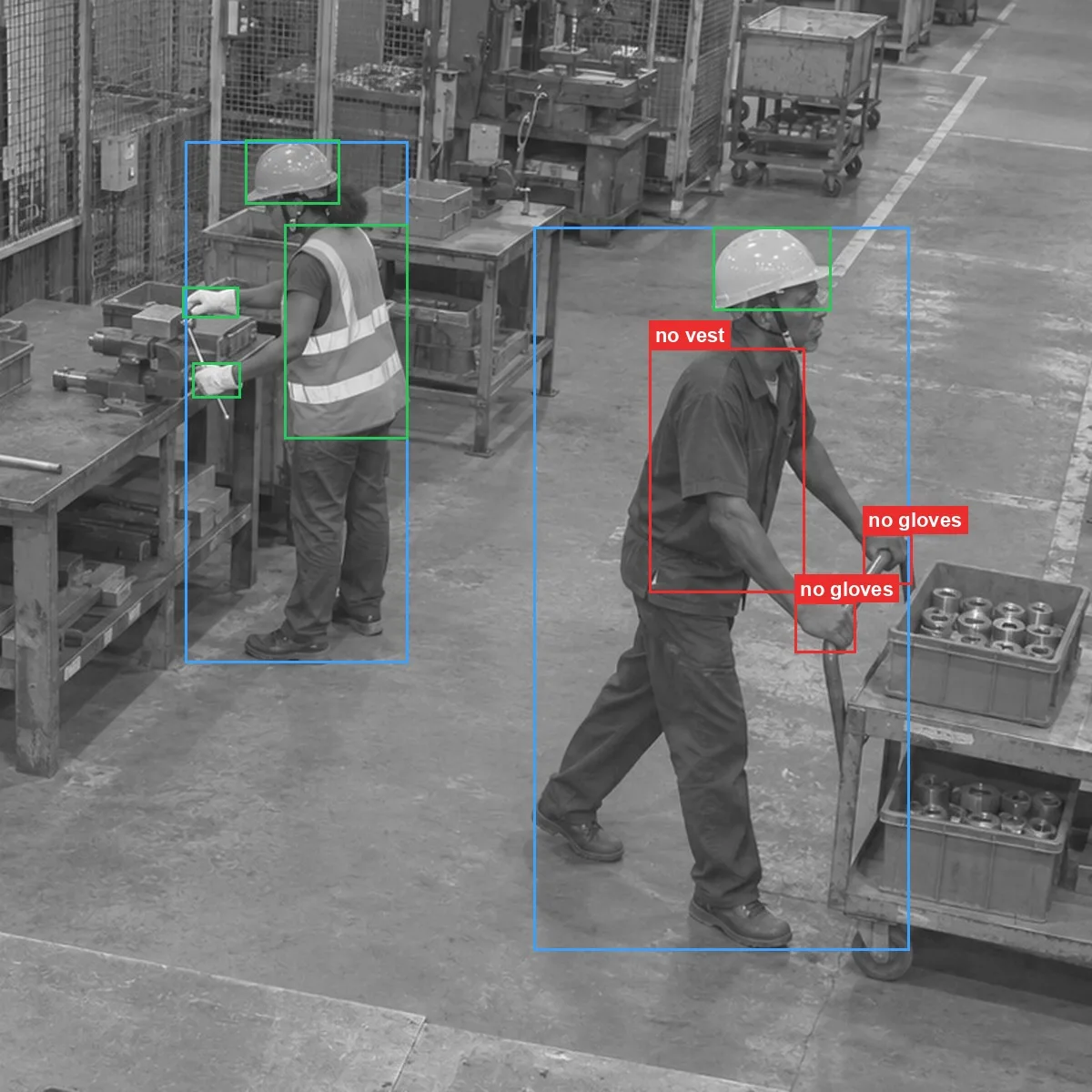
About a quarter of the images are night infrared. Under IR, colour is gone: an orange vest and a grey jacket can look alike, while reflective stripes light up. That is also why the look-alikes matter: on a monochrome frame the difference between a vest and an orange shirt is the stripes, not the colour. The rest of the set covers daylight, overcast, harsh sun, dusk under floodlights, warehouse fluorescent light and rain.
How to evaluate on real footage
Synthetic data is for training. The test that counts is on footage from the cameras you will deploy on. A small, carefully labelled real set beats a large, loosely labelled one:
- Sample your own cameras. A few hundred frames across your sites, times of day and IR, labelled with the same classes and box rules. Keep it out of training.
- Score per worker, not only per box. mAP tells you about boxes. A safety team cares whether each worker was correctly called compliant or not. Assign PPE boxes to person boxes and measure that decision.
- Count false alarms over time. On live video, measure false alerts per camera-hour on footage where everyone is compliant. That number decides whether the alerts get ignored.
- Split the results. Day vs night IR, large vs small workers, construction vs warehouse. Averages hide the cases that fail.
- Use time. A violation that persists for several seconds is worth an alert; a single-frame flicker usually is not. Consider a short persistence rule on top of the detector, and evaluate with it in place.
If you already have a PPE model, the same real test set tells you where it fails before you add any data, and whether adding synthetic violations and look-alikes moves the numbers you care about. Our guide to training YOLO on synthetic data covers mixing synthetic and real images.
Limitations
- No trained model yet. We have not trained a model on this set, so we make no accuracy or mAP claims.
- Small-worker states. Loose chin straps and backwards hard hats can be hard to see on small workers, in the images and so in the labels.
- Not labelled in v1: safety glasses and masks, and the hands of workers smaller than about 20% of the image height.
- Synthetic images. Every image is synthetic, with no real workers. Expect a domain gap to your cameras and check it with real footage.
- Automatic labels. Labels were made automatically, checked by a vision-language model and reviewed visually, not drawn box by box by hand.
Site rules differ too. Some sites require chin straps, gloves or glasses and some do not. Map the classes to your own rules rather than treating every _wrong or no_ box as an alarm.
Dataset specifications
Classes (9):
person, hardhat, hardhat_wrong, no_hardhat, vest, vest_wrong, no_vest, gloves, no_gloves
Full set:
1,000 images, about 75% with at least one violation, 25% fully compliant
Free sample:
200 images on GitHub, Hugging Face and Kaggle
Format:
YOLO TXT and COCO JSON
Perspective:
Fixed CCTV, 3–8 m high, looking down
Conditions:
Day, overcast, harsh sun, dusk floodlights, fluorescent, rain, about 25% night IR
Licence:
Full set: research $149 or commercial $590 for 1,000 images
Get the data
The 200-image free sample lets you check the images and labels and run a first experiment on your own footage before you license anything. The full 1,000-image set and its licences are on the CCTV PPE Compliance Detection Dataset page. For your own camera views, other PPE items or video, see custom datasets.
Common questions
What is the difference between PPE detection and PPE compliance detection?
PPE detection finds hard hats and vests in an image. PPE compliance detection decides whether each worker is wearing them correctly, so a hard hat held in the hand, worn backwards or with a loose chin strap, or a vest worn open or tied around the waist, counts as a violation rather than as PPE present.
Why is a hard hat held in the hand labelled hardhat_wrong?
Because a presence detector would see a hard hat and count the worker as compliant. Labelling it hardhat_wrong teaches the model that a hard hat only counts as hardhat when it is worn correctly on the head. The same worker's bare head also gets a no_hardhat box, so the violation is tied to the person as well as to the hat.
Has a model been trained on the Simuletic PPE compliance dataset?
Not yet, so Simuletic publishes no accuracy or mAP figures for it. Evaluate any model trained on it against a small labelled set of footage from your own cameras.
What does the dataset not label?
Version 1 does not label safety glasses or masks, and it does not label the hands of workers smaller than about 20% of the image height. Loose chin straps and backwards hard hats can be hard to see on small workers.
Continue reading
Related Articles
AI-Generated Video for Construction Scenarios
Simulating realistic construction site scenarios for safety AI.
The First 60 Seconds: Why Most Fire-Detection AI Misses the Fires That Matter Most
Forest-fire datasets won't save a building. Here's how synthetic data finally cracks early-stage CCTV fire detection.
Synthetic Fall Detection Dataset: Training AI Without Staging Accidents
Open-source synthetic dataset for fall and lying down detection in CCTV environments.