CCTV Video Anomaly Detection Datasets
The five public benchmarks compared, the anomaly classes real deployments care about, and which dataset covers each one.
In short: a CCTV anomaly dataset teaches a model where normal ends and an incident begins. The public benchmarks (UCF-Crime, ShanghaiTech, CUHK Avenue, XD-Violence, UBnormal) are good for comparing papers, but they are small, weakly labelled or research-only. For a product you need labelled examples of your own incident classes, from your own camera angle, with look-alike negatives.
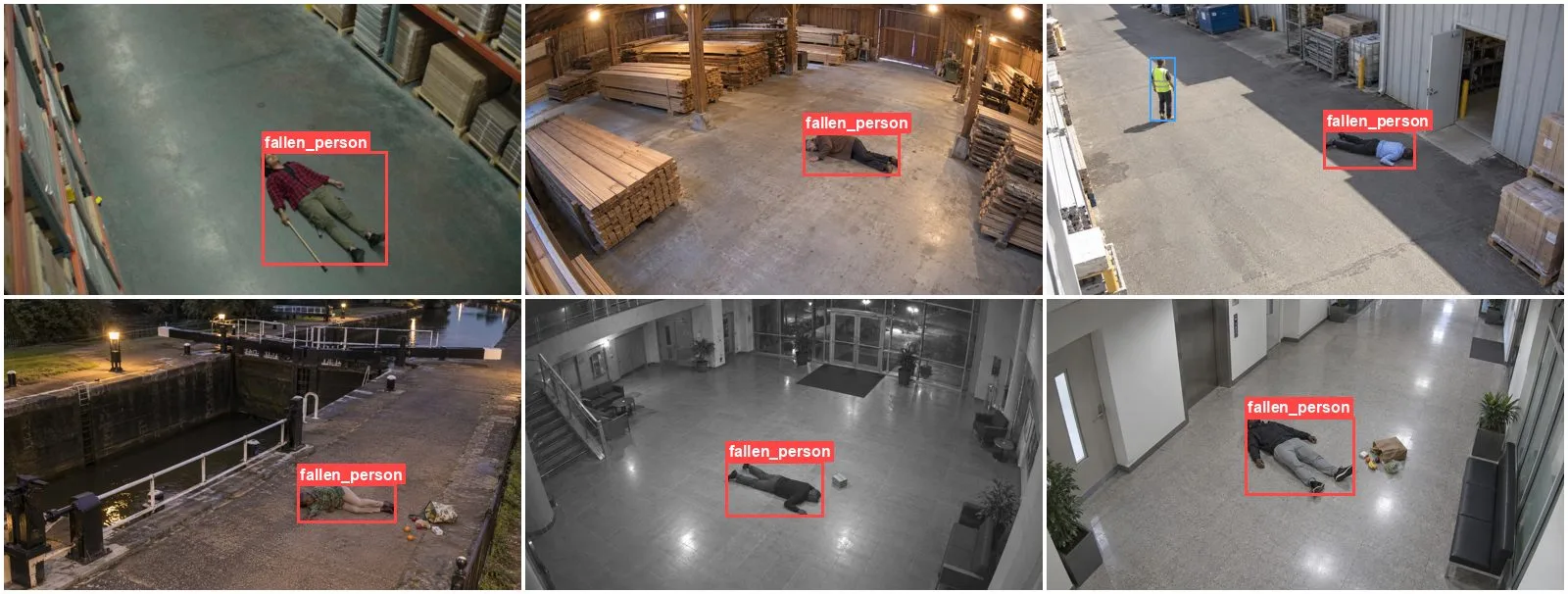
What CCTV anomaly detection actually is
A CCTV video anomaly detection model watches a surveillance feed and flags anything that isn't ordinary: a fall, a fight, a weapon coming out, a person loitering, a bag left behind. Research treats it in two ways. One-class methods learn only what normal looks like for one scene and flag anything that does not fit (ShanghaiTech and Avenue work this way). Weakly supervised methods learn from videos tagged as containing an anomaly somewhere, without saying when (UCF-Crime and XD-Violence work this way).
Products usually need a third approach: supervised detection of named events. A security operator does not want "something unusual on camera 12"; they want "person down" or "knife". That means labelled examples of each event, plus labelled look-alikes so the alarm stays quiet when someone sits on the floor or carries an umbrella.
The clip below shows the kind of event a CCTV model has to catch: a sudden collapse. It is synthetic, made in our pipeline, from a fixed indoor camera.
Example anomaly: sudden collapse. Synthetic clip, no real person filmed. Video like this is made to order; the catalogue fall dataset is labelled images.
The public benchmarks compared
These five sets appear in almost every video anomaly paper. Facts are from each paper or project page; check the licence yourself before any commercial use.
| Dataset | Size | Camera / source | Classes | Licence | Known weakness |
|---|---|---|---|---|---|
| UCF-Crime (2018) | 1,900 untrimmed videos, ~128 h (950 anomalous, 950 normal) | Real CCTV clips collected from YouTube and LiveLeak | 13 anomalies (abuse, arrest, arson, assault, burglary, explosion, fighting, road accident, robbery, shooting, shoplifting, stealing, vandalism) + normal | Research use only, per the project page | Training labels are video-level only; 50 videos per class for most classes; mixed resolutions and compression |
| ShanghaiTech Campus | 437 videos (330 train, 107 test), 130 abnormal events | Fixed campus cameras, 13 scenes | One-class: normal pedestrian traffic vs. abnormal events (e.g. chasing, brawling) | No licence stated on the project page | Anomalies are 'unusual for a walkway', not security incidents; one university campus |
| CUHK Avenue (2013) | 37 clips (16 train, 21 test), 47 abnormal events, ~30K frames | One fixed camera facing a campus walkway | One-class: e.g. running, throwing objects, loitering | No licence stated on the project page | One camera and very small, so results say little about other sites |
| XD-Violence (2020) | 4,754 untrimmed videos, 217 h, with audio | Movies and YouTube: CCTV, handheld cameras, dashcams | 6 violence classes (abuse, car accident, explosion, fighting, riot, shooting) + normal | No licence stated on the project page | Much of it is film and handheld footage, not fixed CCTV geometry; training labels are video-level |
| UBnormal (2022) | 543 videos (268 train, 64 val, 211 test), 29 scenes | Synthetic: animated people rendered (Cinema4D) onto real background photos | Open-set: different anomaly types in train and test, pixel-level labels | CC BY-NC-ND 4.0 (non-commercial) | Stylised characters; the licence rules out commercial training |
Sources: Sultani et al., Real-world Anomaly Detection in Surveillance Videos (CVPR 2018); Liu et al., Future Frame Prediction for Anomaly Detection (CVPR 2018); Lu, Shi and Jia, Abnormal Event Detection at 150 FPS in Matlab (ICCV 2013); Wu et al., Not only Look, but also Listen (ECCV 2020); Acsintoae et al., UBnormal (CVPR 2022).
What the table means in practice
- Licences are the first filter. UCF-Crime is research-only, UBnormal is non-commercial and no-derivatives, and three of the five name no licence at all. "Publicly downloadable" is not the same as "cleared for a product".
- Weak labels. UCF-Crime and XD-Violence training videos say only that an anomaly happens somewhere in the clip. That is fine for ranking papers; it is a poor teacher for a model that must fire within seconds of the event.
- Few examples per class. UCF-Crime has 50 shoplifting videos and 50 fighting videos, each from a different source video. A model trained on that sees each camera angle once.
- No hard negatives. None of the five deliberately includes the look-alikes that cause false alarms in production: sitting on the floor, hugging, carrying an umbrella or a phone.
- Synthetic already works for benchmarks. UBnormal shows the research community accepts rendered anomalies for training and evaluation; its licence just stops you shipping a model trained on it.
The anomaly classes that matter
Real deployments almost always ask for the same short list:
- Falls and medical collapses: care homes, hospitals, stations, workplaces.
- Fights and aggression: nightlife, transport, schools, stadiums.
- Weapons: firearms and knives in shops, banks, transport hubs.
- Shoplifting and concealment: retail loss prevention.
- ATM robbery and hold-ups: banking and self-service.
- Loitering, abandoned objects, intrusion: transport, perimeters, public venues.
- Smoke and fire starting: yards, car parks, depots, warehouses.

Anomaly → Simuletic dataset
Each catalogue dataset is synthetic, seen from real CCTV positions and labelled in YOLO (most also in COCO). Image datasets are licensed as 1,000 images; larger sizes and video are on request.
| Anomaly | Dataset | Classes | What you get |
|---|---|---|---|
| Fall or medical collapse | CCTV Fall & Incident Detection | person, fallen_person | Images, YOLO + COCO |
| Fight, assault, aggression | CCTV Fight & Aggression Detection | person, fight | Images, YOLO-pose + COCO |
| Firearm drawn or carried | CCTV Weapon Detection | person, handgun, rifle, shotgun, sniper_rifle | Images, YOLO + COCO |
| Knife in hand | CCTV Knife Detection | person, knife | Images, YOLO + COCO |
| Weapon look-alikes (false alarms) | CCTV Weapon Detection: Rifles vs Umbrellas | person, rifle, umbrella | Images, YOLO + evaluation clips |
| Shoplifting and concealment | CCTV Shoplifting Detection | person, pose-17kp | 5,000+ frames + 100+ videos, YOLO + VLM |
| ATM robbery / hold-up | CCTV ATM Robbery Detection: Gun & Knife | offender, victim, gun, knife | Images, YOLO |
| Smoke or fire starting | CCTV Smoke & Fire Emergency Detection | person, smoke, fire | Images, YOLO + COCO |
| Loitering, abandoned bag, intrusion | Custom dataset | to your spec | Not in the catalogue: custom pack on your own cameras |
Images or video?
Most production CCTV analytics run a detector on single frames and add simple temporal logic on top: "fallen_person for more than five seconds", "knife box on three consecutive frames". For that, labelled images from the right camera angle carry most of the value, and that is what the catalogue sells. The shoplifting dataset is the exception: concealment is a motion, so it ships with video sequences.
If you train a temporal model (a 3D CNN, a video transformer, or a skeleton sequence model), you need clips with event start and end times. We make those to order on your own camera views, with per-frame boxes and tracking IDs; see custom data.
Why real CCTV data is hard to build on
Building an anomaly dataset from your own footage means waiting for incidents to happen on your cameras, paying people to find and label them, and handling video of identifiable people under GDPR. It is why the public sets above are small and concentrated on a few sites.
Synthetic CCTV turns the problem around: render the event at the camera height, angle and lighting your deployment uses, add the look-alikes, and label it in the same pass. Real footage is still needed, but in a smaller role: as the held-out test set that tells you whether the model works. More on that balance in synthetic data vs real data.

Checklist before you train
- Name the events the alarm must raise, and for each one the three things that look like it.
- Match camera height, angle and resolution to the deployment.
- Check the licence of every dataset in the mix, including the free ones.
- Keep a real, held-out test set from your own cameras, and measure false alarms per camera per day, not only mAP.
- For weapons, test against look-alikes before go-live: our False-Positive Stress Test does this on your detector.
FAQ
What is a CCTV video anomaly detection dataset?
A collection of surveillance video, or frames from it, labelled as normal or abnormal (a fall, a fight, a weapon, a theft, a fire) so a model can learn to flag those events on a live camera feed.
What are the standard public benchmarks for video anomaly detection?
UCF-Crime, ShanghaiTech Campus, CUHK Avenue, XD-Violence and UBnormal. UCF-Crime and XD-Violence cover real incidents with weak video-level labels; ShanghaiTech and Avenue are single-site campus sets; UBnormal is synthetic and non-commercial (CC BY-NC-ND 4.0).
Can I use UCF-Crime for a commercial product?
UCF-Crime's project page says the data is for research purposes only, so it is not a safe basis for a commercial model. Check the terms of every public set before training a product on it.
Do Simuletic datasets ship as video?
Most catalogue datasets are labelled images (1,000 images per licence, YOLO and COCO). The shoplifting dataset includes video sequences, and a few sets add short evaluation clips. Full video datasets with per-frame boxes, tracking IDs and event start/end times are made to order on your own camera views.
Why use synthetic CCTV data for anomaly detection?
Real footage of falls, fights and weapons is rare, sensitive and slow to label. Synthetic data lets you render the event from your own camera angle, with look-alike negatives, without filming a real person; you still validate the model on real footage before deployment.
Also on Simuletic
- Human activity recognition datasets
- 15 video datasets for computer vision, compared
- Fall detection dataset write-up
- Shoplifting detection dataset write-up
- Fight and aggression detection write-up
Need an anomaly class we don't have yet?
Send us the event, a few stills of your empty camera views and the label format. We make custom synthetic images and video with per-frame labels.