Unattended Luggage Detection Datasets: Public Options and What's Missing
The public abandoned-luggage and abandoned-object datasets compared on size, cameras, labels and licence, and the one thing almost none of them label: the bags that are not abandoned.
What an unattended luggage detector has to do
An unattended luggage detector looks at a CCTV view and finds the bags that nobody is with. It is not a bag detector: a busy terminal or station concourse has hundreds of bags, and almost all of them belong to someone standing, sitting or sleeping right next to them.
Most systems split the job in two. A detector finds people and bags in each frame and decides whether each bag has someone with it. Tracking and a timer then decide whether a bag has been alone long enough to raise an alert. The datasets below mostly target the second step, with video of scripted bag drops. The first step, the per-frame decision, is where most false alarms start.
The public datasets compared
The table covers the datasets cited most in abandoned-luggage papers, plus a recent image dataset. Figures come from the papers and pages listed under Sources; where sources disagree, the table says so.
| Dataset | Size | Modality | Scene | Labels | Licence | Main limitation |
|---|---|---|---|---|---|---|
| PETS 2006 | 7 left-luggage scenarios | Video, 4 cameras per scenario | UK train station concourse | Task rules (2 m / 3 m / 30 s), event level | Research and educational use | Scripted actors; only 7 events |
| PETS 2007 | 8–9 sequences (sources differ) | Video, 4 cameras | Public transport hub (site not confirmed) | Events: loitering, luggage left, swap, theft; separate tracking ground truth | Research use (ground truth: research only) | Scripted; few abandonment events |
| AVSS 2007 / i-LIDS bag challenge | Easy, medium and hard sample clips | Video, single viewpoint | Station concourse | Event level | Full i-LIDS restricted to VA manufacturers and academic groups | Hard to access today |
| ABODA | 11 videos | Video | Indoor and outdoor, crowded, night, lighting changes | Not documented | None stated | No documented labels or licence |
| CAVIAR | 5 left-bag scenarios (of 28 + 26 sequences) | Video, 384×288, 25 fps | INRIA lobby and a Lisbon shopping centre | Per-person boxes and roles (XML) | CC BY-SA | Low resolution; not a transport hub |
| SERD | 11 videos, 4 scenes | Video | University campus | Event counts: abandoned, moved by owner or non-owner, theft | No public download found | Not publicly available |
| CCTV-KD (Sensors, 2025) | About 470 images, 9,174 boxes | Still images | Rijeka promenade and Düsseldorf Airport | person and luggage boxes | Repository public; no dataset licence stated | No attended / unattended label per bag |
Notes on each
- PETS 2006 is the reference benchmark. Its seven scenarios grow in difficulty, each filmed by four cameras in a UK train station. Its task rules are still the common definition: the owner within 2 m means attended, beyond 3 m means unattended, and the alarm follows after 30 seconds.
- PETS 2007 broadens the events to loitering, luggage swaps and theft. Papers disagree on whether it has eight or nine sequences, so count the files you download. A separate manual tracking ground truth is available for research use.
- AVSS 2007 / i-LIDS clips come from the UK Home Office i-LIDS library, filmed on a station concourse at easy, medium and hard distances. The i-LIDS user guide limits the full datasets to video analytics manufacturers and relevant academic groups.
- ABODA has 11 videos chosen to be hard: crowds, sudden lighting changes, night and outdoor scenes. Its repository documents no annotation format and no licence.
- CAVIAR is often misdescribed as station footage. It was filmed in a lobby at INRIA and in a Lisbon shopping centre at 384×288, and only a handful of its scenarios involve a left bag. It is CC BY-SA.
- SERD goes past "left behind" to who picks the bag up: the owner, someone else, or a thief. We found no public download.
- CCTV-KD is a recent still-image set from a pedestrian zone and Düsseldorf Airport, with about 9,000 person and luggage boxes. The paper decides abandonment with rules on top of tracks, so the images carry no per-bag abandonment label.
Roboflow Universe also hosts community sets named "abandoned objects" or "left bags", from a few hundred to a few thousand images, ready to export as YOLO. Their pages mostly do not say how a bag was judged abandoned, so check a sample of labels before training on one.
What's missing: the attended bags
None of the datasets above labels, in a still frame, which bags have someone with them and which do not. The classic benchmarks label events in video, and the newer image sets label every bag the same way.
That leaves out the cases operators actually complain about. A bag next to a traveller asleep on a gate bench looks alone to a detector. So does a suitcase at the feet of someone on the phone, a backpack beside a seated student, or a bag on a trolley whose handle is just out of frame. A model only ever shown scripted drops in an empty concourse has never been told these are fine.
The other gap is crowd density. The benchmarks were filmed with a few actors in a mostly quiet space; real terminals have dozens of people and bags in one view, many of them small at CCTV distance.

How to label unattended luggage in still frames
A per-frame label needs a rule that can be applied from one image. The one we use follows the PETS idea of distance to the owner, plus the postures that fool distance-only rules:
- luggage: someone is with the bag. They hold or pull it, push it on a trolley, stand with it at their feet, or sit, sleep or stand beside it within about one step.
- unattended_luggage: the bag is set down on the floor, a seat or by a wall or pillar, and the nearest person is walking past or more than about two metres away.
- Not boxed: bags worn on the body, and look-alikes that are not luggage, such as bin bags and cleaning carts.
The timer stays in the system, not in the labels: a detector trained this way says "this bag has nobody with it now", and your tracker decides when that becomes an alert.
Our Airport CCTV Unattended Luggage Detection Dataset
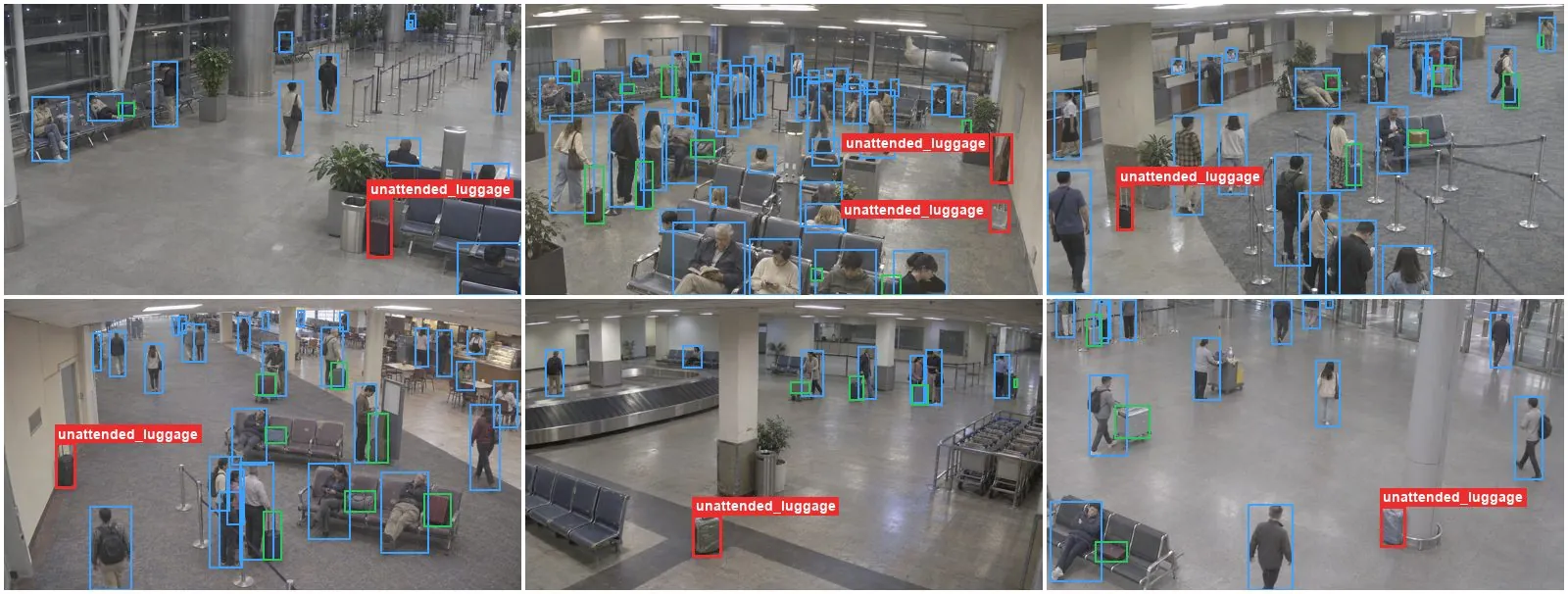
The Airport CCTV Unattended Luggage Detection Dataset is built for the per-frame step the public sets leave out.
- 1,000 synthetic images of busy terminals: check-in, the approach to security, gate seating, baggage reclaim, the arrivals exit, and corridors and food courts.
- Wall and ceiling CCTV views 4 to 10 m high, by day, in evening fluorescent light, late at night and in infrared.
- About 20 people and 8 bags per image; about 65% of images have at least one unattended bag, the rest only attended ones.
- Owners asleep or seated beside their bags, bags on pushed trolleys and bags at the owner's feet, all labelled attended.
- Classes person, luggage and unattended_luggage in YOLO and COCO, with a train / val split.
- Synthetic, so no traveller is filmed, and signs carry no readable text or logos.
The full dataset is available on request with a Research ($149) or Commercial ($590) licence; see pricing. Stations, stadiums, your own camera views or video clips with tracking IDs can be made through custom data.
Frequently asked questions
What is the standard dataset for abandoned luggage detection?
PETS 2006 is the most cited. It has seven left-luggage scenarios filmed by four cameras in a UK train station, and it defined the rules many later papers reuse: a bag is attended while its owner is within 2 m, unattended beyond 3 m, and an alarm is raised after 30 seconds. PETS 2007 and the AVSS 2007 / i-LIDS abandoned-baggage clips are the other classic benchmarks.
Is there an abandoned object detection dataset in YOLO format?
Yes, but few are documented. Community sets on Roboflow Universe export to YOLO, though most do not state how a bag was judged abandoned. The CCTV-KD set from a 2025 Sensors paper labels person and luggage, not abandonment. Simuletic's Airport CCTV Unattended Luggage Detection Dataset has YOLO and COCO labels with separate luggage and unattended_luggage classes.
Why do left-luggage systems raise so many false alarms?
Because a bag that looks alone often is not: the owner is asleep or seated next to it, on the phone a step away, or pushing it on a trolley. A detector trained only to find bags, or only on scripted drops, has never been shown these cases labelled as attended.
Do I need video or images to detect unattended luggage?
Both, for different parts. A per-frame detector finds people and bags and says which bags have nobody with them. Tracking and a timer then decide whether a bag has been alone long enough to alert. The detector needs many varied still frames; the timer needs fewer, well-labelled clips.
Can I use PETS or i-LIDS data commercially?
Check before you do. PETS data is listed as free for research and educational use, and the i-LIDS user guide restricts the full datasets to video analytics manufacturers and relevant academic groups. CAVIAR is CC BY-SA. ABODA's repository states no licence. Get written permission before shipping a model trained on any of them.
Also on Simuletic
- Training data for AI security cameras
- CCTV video anomaly detection datasets
- Airport Drone Threat & Safety Dataset
Sources
- Smith et al., Detecting Abandoned Luggage Items in a Public Space (PETS 2006 workshop, Idiap report)
- Dalley et al., Event Detection Using an Attention-Based Tracker (PETS 2007)
- Ground truth for the PETS 2007 benchmark video (Curtin University)
- AVSS 2007 i-LIDS bag and vehicle detection challenge (QMUL)
- i-LIDS user guide (UK Home Office)
- Real-Time Deep Learning Method for Abandoned Luggage Detection in Video (arXiv 1803.01160)
- ABODA: Abandoned Object Dataset (GitHub)
- CAVIAR test case scenarios (University of Edinburgh)
- Security Event Recognition for Visual Surveillance (SERD, arXiv 1810.11348)
- A System for Real-Time Detection of Abandoned Luggage, Sensors 25(9):2872, 2025
The bag nobody is with
1,000 airport CCTV images with person, luggage and unattended_luggage boxes, including sleeping and seated owners. Available on request.