Fall Detection Model
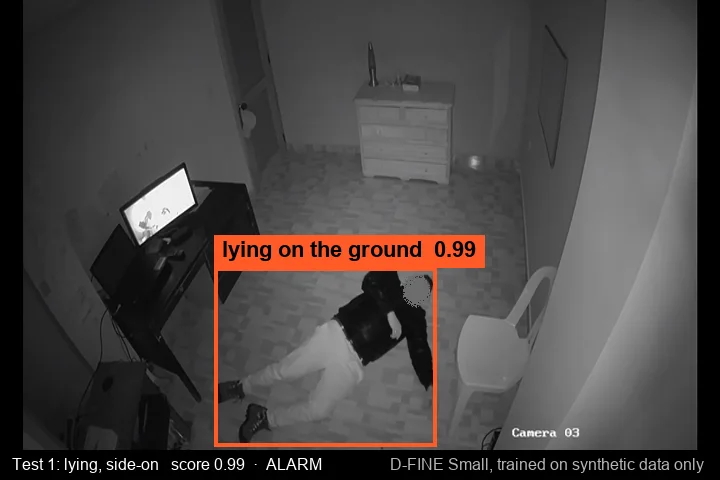
A small detector trained only on synthetic CCTV images and measured on real footage it never saw. It catches 95.6% of people lying on the floor at 1% false alarms and 94.5% of falls in a home it never saw. The 2-second alarm caught every staged fall with no false alarms. Free to download for research and evaluation.
Released 15 November 2026: weights, code and a notebook are public. Free for non-commercial research and evaluation. Commercial use and the Pro model need a licence.
See it run
On real footage it never saw
Get the model
Free for research. Licensed for products.
Weights, code and a notebook are public. The weights are free for non-commercial research and evaluation (CC BY-NC 4.0); the code is Apache-2.0.
Commercial use
Pro model and commercial licence
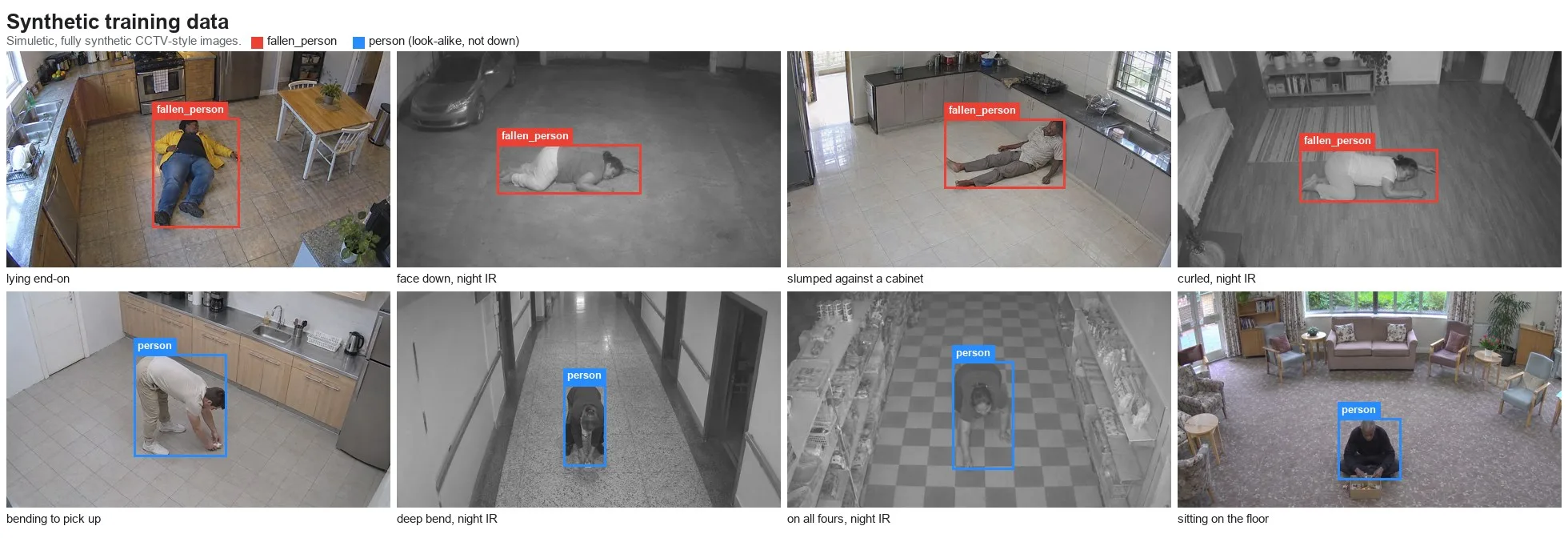
- Trained on 10,000+ images: more night infrared, camera heights and look-alikes
- Edge builds
- Commercial licence and support
- Optional fine-tuning on your own camera views
Products, pilots and paid services need a commercial licence.
Headline results
Measured on real footage the model never saw
Nano (recommended)
3.7 M params · recommended for most uses; small enough for edge boxes- 95.6%
- Lying frames caught at 1% false alarms
- 0.995
- Frame AP
- 94.5%
- Falls caught in a different home
- 100%
- Falls caught by the 2-second alarm, no false alarms
Test 1, range 94.8–96.1%
Test 1
Test 2, at 10% clip false alarms
Test 1, all 24 falls, every seed
Mean of 3 training seeds. The published weights are seed 0, chosen by a rule fixed before the results.
Small
10.2 M params · slightly higher recall in the second home- 79.8%
- Lying frames caught at 1% false alarms
- 0.975
- Frame AP
- 96.8%
- Falls caught in a different home
- 60%
- Falls caught by the 2-second alarm, no false alarms
Test 1, range 74.2–85.5%
Test 1
Test 2, at 10% clip false alarms
Test 1; one long, deep bend still alarms
Mean of 2 training seeds. Small still takes one long, deep bend (held for more than 4 seconds) for a fall, so prefer Nano where look-alikes matter.
Specification
What it is
- Task
- Detects a person lying on the floor after a fall, with a 2-second stays-down alarm, and stays quiet for bending, kneeling, sitting, standing and walking.
- Architecture
- Nano (recommended): D-FINE Nano (DETR-style detector), fine-tuned from the public COCO checkpoint. Small: D-FINE Small, fine-tuned from the public COCO checkpoint with the same recipe.
- Parameters
- Nano (recommended) 3.7 M · Small 10.2 M
- Licence
- Weights: CC BY-NC 4.0 (non-commercial research and evaluation). Code: Apache-2.0. Commercial licence on request.
- Trained on
- CCTV Fall & Incident Detection Dataset plus targeted synthetic top-ups: about 1,580 synthetic images, no real frames.
- Training recipe
- Fine-tuned from public COCO checkpoints for 60 epochs at 640 px, with the pretrained feature layers at a 10× lower learning rate than the head. Trained on about 1,580 synthetic images and no real frames: the 1,000-image CCTV Fall & Incident Detection Dataset plus targeted top-ups (people lying end-on or partly hidden, and look-alikes such as deep bends, kneeling, crawling and sitting on the floor, about half of them night infrared).
- Speed
- Nano (recommended): 16 ms per 640 px frame on an Apple M4 Pro GPU, 94 ms on its CPU (PyTorch, including pre- and post-processing). Small: 22 ms per 640 px frame on an Apple M4 Pro GPU, 132 ms on its CPU.
- Edge and camera chips
- PyTorch and ONNX for both sizes; runs on GPUs and Jetson-class edge boxes. Builds for camera chips are part of the Pro model.
- Release
- Free for research and evaluation: weights (Nano and Small, PyTorch and ONNX) on Hugging Face and Kaggle, inference code, the 2-second alarm and the scoring scripts on GitHub, and a Kaggle notebook on real footage. Commercial use needs a licence; the Pro model is trained on request.
Real test sets
Tested on
CAUCAFall, subjects 6–10 (Test 1)
1,923 frames, 615 lying; one staged room, never trained on
CC BY 4.0 →Full table
Every model and data combination we scored
| Model | Train data | Params | T1 AP | T1 @5% FA | T1 @1% FA | T1 end-on @5% | T2 clip AP | T2 falls @5% | T2 falls @10% |
|---|---|---|---|---|---|---|---|---|---|
| D-FINE Small | synthetic | 10.2 M | 0.985 | 97.4% | 83.1% | 90.1% | 0.984 | 82.3% | 89.9% |
| D-FINE Nano (seed 0) | synthetic | 3.7 M | 0.972 | 92.7% | 74.8% | 64.0% | 0.953 | 59.5% | 87.3% |
| D-FINE Nano (seed 1) | synthetic | 3.7 M | 0.937 | 90.2% | 51.7% | 54.0% | 0.967 | 67.1% | 83.5% |
| D-FINE Nano (seed 2) | synthetic | 3.7 M | 0.971 | 91.9% | 83.6% | 61.3% | 0.961 | 65.8% | 83.5% |
| D-FINE Nano | real only | 3.7 M | 1.000 | 100% | 100% | 100% | 0.850 | 22.8% | 24.1% |
| D-FINE Nano | mixed | 3.7 M | 1.000 | 100% | 99.5% | 100% | 0.958 | 57.0% | 89.9% |
| Two-stage (MobileNetV4 crop classifier) | synthetic | 6.3 M | 0.895 | 77.6% | 71.2% | 6.3% | 0.978 | 84.8% | 88.6% |
| Two-stage | real only | 6.3 M | 0.881 | 77.1% | 39.2% | 73.9% | 0.914 | 49.4% | 54.4% |
| Two-stage | mixed | 6.3 M | 0.948 | 91.2% | 80.6% | 73.9% | 0.973 | 86.1% | 92.4% |
| RF-DETR Nano | synthetic | 30.2 M | 0.898 | 88.3% | 16.1% | 61.3% | 0.955 | 46.8% | 93.7% |
| YOLO26nAGPL reference | synthetic | 2.5 M | 0.449 | 19.4% | 19.4% | 1.8% | 0.755 | 7.6% | 13.9% |
| YOLO26n, feature layers frozenAGPL reference | synthetic | 2.5 M | 0.813 | 73.0% | 41.8% | 40.5% | 0.884 | 26.6% | 26.6% |
| YOLO26nAGPL reference | real only | 2.5 M | 0.866 | 70.9% | 13.7% | 82.9% | 0.746 | 10.1% | 15.2% |
| YOLO26nAGPL reference | mixed | 2.5 M | 0.940 | 87.8% | 39.4% | 82.9% | 0.801 | 20.2% | 31.6% |
| YOLO26sAGPL reference | synthetic | 10.0 M | 0.380 | 12.5% | 11.1% | 0.0% | 0.668 | 2.5% | 11.4% |
Test 1: CAUCAFall subjects 6–10 (1,923 frames, 615 lying), one staged room; in-domain for the real-only and mixed models, which trained on subjects 1–4 of the same set. Test 2: GMDCSA-24, 160 clips from a different home, the fair cross-domain test for every model. Bed and sofa clips are left out. YOLO26 is Ultralytics' AGPL-3.0 model, measured as a reference and never distributed.
Honest limits
Caveats and what we do not claim
Caveats
- Both real tests are staged, small and indoor, with few actors.
- Small still alarms on one long, deep bend in Test 1; Nano does not.
- Speed was measured on an Apple M4 Pro, not on edge hardware.
Not claimed until measured
- Public spaces, real night-time infrared CCTV, long distance or crowds: not measured yet.
- The falling motion itself: the model reports a person lying on the ground or floor, so the alarm comes when someone is down, not mid-fall.
- Lying in bed or on a sofa: out of scope; a care-home bed product needs its own negatives.
- Production readiness or medical use: these are research previews measured on two staged indoor sets.
Read more
The training data, the test and the method
Training dataset
CCTV Fall & Incident Detection Dataset: license it to train your own model
Case study
A lying-on-the-ground detector trained only on synthetic CCTV images, tested on real footage from two homes
Engineering guide
Training a lying-on-the-ground detector on synthetic data only: D-FINE vs RF-DETR vs YOLO
Using it in a product?
The free weights are for research and evaluation. For products, pilots or paid services, get a commercial licence or the Pro model: more training data, edge builds, support and fine-tuning on your camera views.