 Behaviour & safety
CCTV Fall & Incident Detection
Synthetic fall detection dataset: 1,000 CCTV images of fallen people plus sitting and kneeling look-alikes, labelled person / fallen_person in YOLO and COCO.
- Size
- 1,000 images
- Format
- YOLO + COCO
Watch
GMDCSA-24, subject 1, clip 03 (MIT licence): a person falls from a chair to the floor. The score of the synthetic-only D-FINE Small is shown on every frame; the box appears when it passes 0.5. The first three seconds (sitting, then falling) score 0.03–0.09 and stay silent; from the moment the person is on the floor the score is 0.98–0.99 for the rest of the clip, 88 of 178 frames.
This is what the dataset teaches: the state of lying on the ground, not the falling motion. The second around the fall onset is excluded from scoring for the same reason.
Clip from GMDCSA-24 (Alam et al.), published under the MIT licence; overlay rendered by us. Also on its own page.
We trained D-FINE, RF-DETR and YOLO on our 1,000-image Fall dataset and nothing else, then scored them on two public real-footage sets. The synthetic-only D-FINE Small catches 97% of people on the floor at 5% false alarms; the model trained on real footage from one room catches 24% of falls in another home.
Trained only on
CCTV Fall & Incident Detection Dataset1,000 synthetic CCTV images, 178 confusers. Licensable, with a free sample.
Question
Every CCTV analytics vendor claims fewer false alarms; almost none publishes a test. We wanted a number before showing a model, and the number had to come from real footage the model had never seen.
So we took our CCTV Fall & Incident Detection Dataset (1,000 synthetic images: 900 train, 100 validation, 178 of them confusers such as sitting, kneeling, crouching, squatting), trained five detector designs on it and nothing else, and scored them on two public real-footage sets. For comparison we also trained the same designs on real footage only, and on real plus synthetic.
Proof
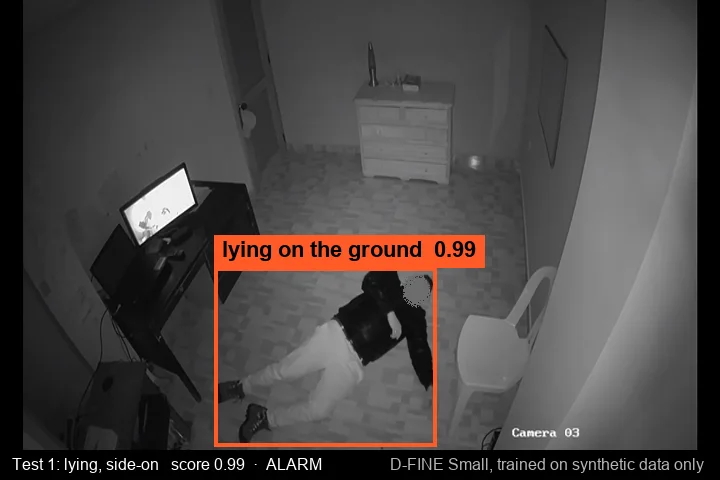
Test 1, subject 6, fall backwards. The model's box and score are drawn as the model output them.
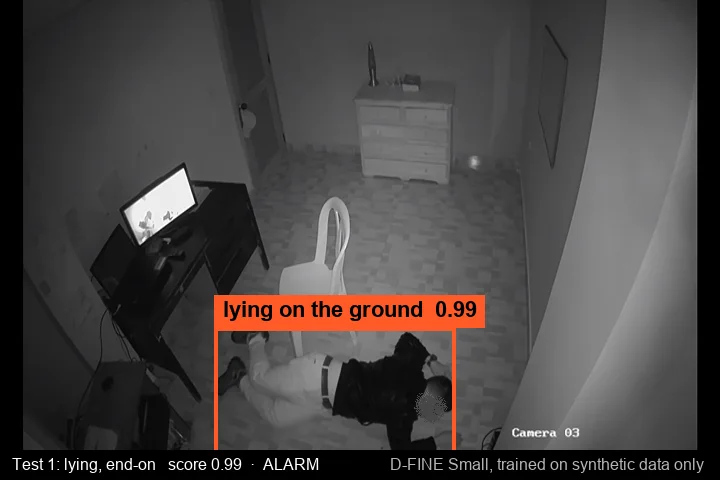
Foreshortened lying is the harder case; the Small model catches 90% of these frames at 5% false alarms.
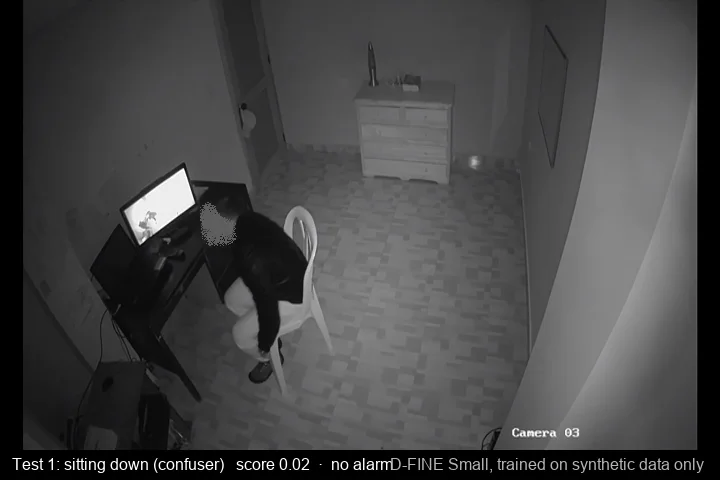
The confuser the synthetic set is built around. Score 0.02.
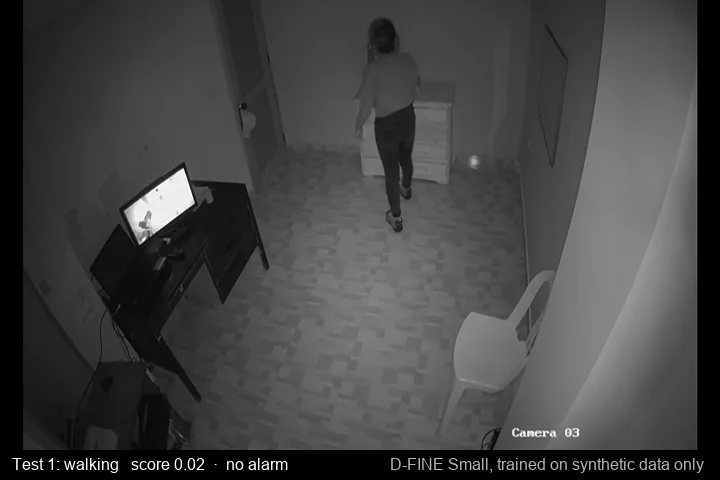
Normal activity frames make up two thirds of Test 1.
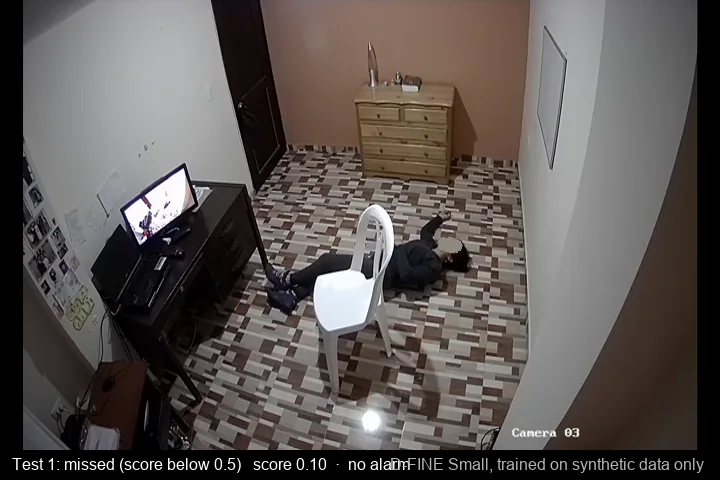
Subject 7, fall from sitting: the person is on the floor but the score stays at 0.10. Partly hidden, low-contrast poses are where the misses cluster.
The chart
Results
| Model | Train data | Params | T1 AP | T1 @5% FA | T1 @1% FA | T1 end-on @5% | T2 clip AP | T2 falls @5% | T2 falls @10% |
|---|---|---|---|---|---|---|---|---|---|
| D-FINE Small | synthetic | 10.2 M | 0.985 | 97.4% | 83.1% | 90.1% | 0.984 | 82.3% | 89.9% |
| D-FINE Nano (seed 0) | synthetic | 3.7 M | 0.972 | 92.7% | 74.8% | 64.0% | 0.953 | 59.5% | 87.3% |
| D-FINE Nano (seed 1) | synthetic | 3.7 M | 0.937 | 90.2% | 51.7% | 54.0% | 0.967 | 67.1% | 83.5% |
| D-FINE Nano (seed 2) | synthetic | 3.7 M | 0.971 | 91.9% | 83.6% | 61.3% | 0.961 | 65.8% | 83.5% |
| D-FINE Nano | real only | 3.7 M | 1.000 | 100% | 100% | 100% | 0.850 | 22.8% | 24.1% |
| D-FINE Nano | mixed | 3.7 M | 1.000 | 100% | 99.5% | 100% | 0.958 | 57.0% | 89.9% |
| Two-stage (MobileNetV4 crop classifier) | synthetic | 6.3 M | 0.895 | 77.6% | 71.2% | 6.3% | 0.978 | 84.8% | 88.6% |
| Two-stage | real only | 6.3 M | 0.881 | 77.1% | 39.2% | 73.9% | 0.914 | 49.4% | 54.4% |
| Two-stage | mixed | 6.3 M | 0.948 | 91.2% | 80.6% | 73.9% | 0.973 | 86.1% | 92.4% |
| RF-DETR Nano | synthetic | 30.2 M | 0.898 | 88.3% | 16.1% | 61.3% | 0.955 | 46.8% | 93.7% |
| YOLO26nAGPL reference | synthetic | 2.5 M | 0.449 | 19.4% | 19.4% | 1.8% | 0.755 | 7.6% | 13.9% |
| YOLO26n, feature layers frozenAGPL reference | synthetic | 2.5 M | 0.813 | 73.0% | 41.8% | 40.5% | 0.884 | 26.6% | 26.6% |
| YOLO26nAGPL reference | real only | 2.5 M | 0.866 | 70.9% | 13.7% | 82.9% | 0.746 | 10.1% | 15.2% |
| YOLO26nAGPL reference | mixed | 2.5 M | 0.940 | 87.8% | 39.4% | 82.9% | 0.801 | 20.2% | 31.6% |
| YOLO26sAGPL reference | synthetic | 10.0 M | 0.380 | 12.5% | 11.1% | 0.0% | 0.668 | 2.5% | 11.4% |
Test 1: CAUCAFall subjects 6–10 (1,923 frames, 615 lying), one staged room; in-domain for the real-only and mixed models, which trained on subjects 1–4 of the same set. Test 2: GMDCSA-24, 160 clips from a different home, the fair cross-domain test for every model. Bed and sofa clips are left out. YOLO26 is Ultralytics' AGPL-3.0 model, measured as a reference and never distributed.
What it shows
01
D-FINE Nano trained on real CAUCAFall footage is perfect on more CAUCAFall footage (same room, same camera). In a different home (Test 2) it catches 24% of falls. The same model trained only on our synthetic images catches 83–87%.
02
Perfect in-domain and 90% of falls in the new home. The same pattern holds for the two-stage design: 54% real-only versus 92% mixed on Test 2.
03
97.4% of lying frames at 5% false alarms on Test 1, and 90% of end-on lying. Frame AP 0.985.
04
Three D-FINE Nano runs span frame AP 0.937–0.972 on Test 1; the strict 1% false-alarm setting varies most (52–84%). We never quote the best seed.
05
Freezing YOLO26n's pretrained feature layers lifts Test 1 AP from 0.45 to 0.81: the default recipe overwrites real-world features when training on synthetic images. D-FINE's lower learning rate on those layers is part of why it transfers.
06
Left out of Test 2 by design. For information: the synthetic models alarm on 24–32% of bed clips at the 10% setting, so a care-home bed product would need its own negatives.
Limits
Next
400 targeted synthetic images (end-on lying, partly hidden by furniture, chair and sitting-down confusers, about a third night infrared) added to the training set, with the 1K-only runs kept as controls so the effect of the new images is measured, not assumed.
New tests: public-space CCTV with real elevated cameras, and negative camera-hours to report false alarms per 100 camera-hours with confidence intervals.
Data and credits
FAQ
No. Test 1 uses CAUCAFall subjects 6–10, while the real-only and mixed models trained on subjects 1–4 of the same set (same room, same camera, so Test 1 is in-domain for them). Test 2, GMDCSA-24, is a different home that no model saw.
Whether a person is lying on the ground or floor, versus sitting, kneeling, standing or walking. The second either side of each fall onset is excluded, as are frames the dataset relabels "no fall" while the person is still down. Lying in bed or on a sofa is out of scope.
Because it is a rate an operator can live with on a single camera, and because it exposes the difference between models that a lenient threshold hides. We also report 1% (strict) and, on clips, 5% and 10% clip false-alarm rates.
Yes. Both test sets are public (CAUCAFall CC BY 4.0, GMDCSA-24 MIT) and the scoring code is published with the round-1 scorecard. Weights follow after round 2.
Nothing yet. Both test sets are staged, indoor, daytime and small. Round 2 adds public-space CCTV tests before any such claim.
The training data
The models in this test saw no real frames: they learned from the CCTV Fall & Incident Detection Dataset alone. 1,000 synthetic CCTV images, 900 for training and 100 for validation, with 178 confusers (sitting, kneeling, crouching, squatting) so the model learns the difference between someone on the floor and someone just low.
License the dataset to train your own detector, or add it to your real footage: in this test, synthetic plus real caught 90% of falls in a new home against 24% for real footage from one room. Or ask for early access to the trained Fall Detection Model.
Behaviour & safetySynthetic fall detection dataset: 1,000 CCTV images of fallen people plus sitting and kneeling look-alikes, labelled person / fallen_person in YOLO and COCO.
Under a scoring-only agreement we fine-tune on your views, score on your footage and report the same table. Nothing leaves your premises except the numbers you approve.